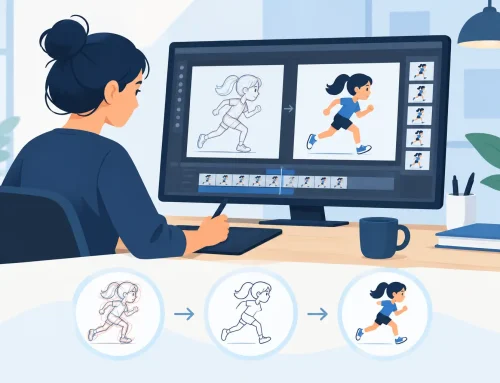
A useful animated short cleanup example does not begin with a beautiful line. It begins with a rough scene that already works: the character’s weight lands correctly, the action reads at speed, and the timing carries the idea. Cleanup has one job above all others – preserve that life while making every drawing clear enough to paint, composite, and show.
Consider a short three-second shot: a small character runs into frame, skids to a stop, looks up, and raises an arm. The rough animation is energetic but untidy. Head sizes drift, hands are indicated with quick circles, and the line of the torso changes from drawing to drawing. That is normal. The cleanup artist is not there to trace those mistakes faithfully. The artist is there to make deliberate production drawings without sanding away the performance.
What This Animated Short Cleanup Example Shows
This shot might contain 36 frames at 12 drawings per second, with holds where the action needs them. The rough animator has established the important poses: the run, the extreme skid, the compressed settle, the eye-line change, and the arm-up pose. Before cleaning a single inbetween, identify those storytelling drawings first.
The cleaned version should answer a few practical questions immediately. Can another artist tell which side of the character is facing camera? Does the character stay on model? Are overlapping forms separated clearly enough to paint? Does the line weight support the action rather than clutter it?
A clean drawing is not necessarily a smooth drawing. During the skid, for example, a slightly sharper angle in the body and a compressed cheek may make the stop feel stronger. If cleanup makes every contour soft and even, it can weaken the impact that made the rough appealing in the first place.
Start with the key poses, not every frame
Clean the strongest keys before committing to the whole scene. In this example, begin with the contact pose in the run, the widest skid pose, the settled stop, and the arm-up pose. These drawings establish the character’s proportions and give the inbetweens something reliable to connect.
Use simple construction to check them. A centerline through the head tells you whether the face turns consistently. A shoulder line and hip line reveal whether the torso is twisting or merely changing shape by accident. The feet need special attention because they carry the weight of the shot. A foot planted on the ground should not slide because a cleaned contour was placed differently from frame to frame.
Do not force every key to match a character model sheet with mechanical precision. A model sheet is a guide to the character’s identity, not a reason to erase a good squash, stretch, or perspective change. The practical standard is consistency of intent: the character should look like the same character while doing the action.
Clean the silhouette before the details
At playback speed, viewers read the outside shape first. In the skid drawing, separate the raised shoulder from the head. Leave enough negative space between the arm and torso when the arm goes up. Keep the near hand clear of the face unless the pose is meant to hide it.
This is why cleanup artists should regularly flip between the rough and cleaned layers and play the scene rather than judging frames one at a time. A contour can look elegant as a still image yet create a distracting boil in motion. Conversely, a line that looks slightly odd on one frame may be exactly what the action needs when viewed in sequence.
Once the silhouette is working, clarify interior lines. Use them to explain form, overlap, and direction. Avoid decorating the drawing with unnecessary folds, tiny facial marks, or stray texture that will flicker during playback and slow the painting stage.
A Production Cleanup Pass, Step by Step
For this kind of animated short, the best cleanup workflow follows the order of the animation rather than the order of the toolbar. First, set up the roughs so their timing can be read clearly. Then make decisions on the keys. Only after the keys are solid should you clean breakdowns and inbetweens.
In the running section, the character may be animated on twos. Preserve that exposure unless the rough calls for a change. During the fast skid, you may hold an extreme for an extra frame or introduce a single-frame smear. Cleanup must respect those choices. A perfectly drawn smear that is exposed for the wrong duration is still wrong.
For each drawing, use the rough as a performance guide, not a line-for-line template. Place the head mass, torso, and feet first. Check the character’s screen direction. Then commit to the final contour and add only the internal lines needed to make the pose readable. This order prevents the common mistake of finishing a face or hand before discovering that the body beneath it needs to move.
Keep line quality purposeful
Line quality is part of the acting. A confident outer contour helps a character feel solid. A thinner interior line can indicate a plane change or overlap without competing with the silhouette. The exact approach depends on the production style: a simple cartoon design may need nearly uniform lines, while a more expressive hand-drawn film can benefit from visible variation.
What matters is consistency across the shot. If the character has bold outlines in one drawing and faint, hesitant contours in the next, the image will pulse. Use a brush that gives you control at the size the film will actually be seen. Cleaning at an extreme zoom can tempt you into polishing detail that disappears at normal viewing size.
The same rule applies to line intersections. Decide which form is in front and let one line win. Tangled intersections around the shoulder, fingers, or clothing create problems for both the audience and the painter.
Check timing while you draw
Timing changes are often discovered during cleanup. Perhaps the settle after the skid is too quick, so the character appears to bounce instead of stop. Perhaps the arm raise needs one more held drawing so the audience has time to register what the character sees. These are animation decisions, not administrative corrections.
A traditional workflow becomes slow when changing exposure means stopping, editing a timeline, and previewing again and again. Real-time timing control is valuable because it lets you play the scene, adjust the hold, and judge the result in the same creative pass. In FlipBook, that direct approach helps cleanup stay connected to motion instead of becoming a stack of isolated drawings.
Still, do not use timing changes to hide weak drawings. If the action bumps because the head rotates unevenly or the planted foot drifts, repair the drawings first. Timing can strengthen a clear action; it rarely rescues an unclear one.
Common Cleanup Mistakes in Short Scenes
The first mistake is over-cleaning. Artists sometimes remove every asymmetry, every rough edge, and every unexpected shape until the character feels posed rather than alive. Keep the rough’s energy where it serves the action. Clean the information, not the personality out of it.
The second is treating inbetweens as less important than keys. A bad inbetween can make a good key look wrong. In the run-to-skid transition, pay attention to spacing. The drawings should show acceleration into the stop and compression at the impact. Even spacing will make the character float through the action.
The third is ignoring paintability. Closed shapes, clear overlaps, and stable line placement make color faster and reduce repair work later. That does not mean every line must meet perfectly in a style that uses open contours. It means the painter should be able to understand the intended form without guessing.
Finally, do not judge cleanup only at full resolution. Scrub slowly to inspect construction, then play at normal speed to inspect movement. If possible, step away and return with fresh eyes. A small wobble that became invisible after an hour of drawing often appears immediately after a short break.
When the Scene Is Ready for Paint
The scene is ready when the cleaned drawings maintain the rough’s acting, the character stays convincingly on model, and each exposure supports the intended rhythm. At that point, painting should feel like finishing the shot, not deciphering it.
Before moving on, run the whole scene with its neighboring shots if they are available. A cleanup choice that works alone may look too heavy, too tight, or too slow next to the surrounding animation. Short films are built from shots, but audiences experience one continuous flow.
Keep that standard in mind on every frame: the best cleanup is almost invisible. Viewers should see the run, feel the skid, understand the look upward, and believe the arm raise. When the drawing serves those moments cleanly, the animation is ready to come alive.