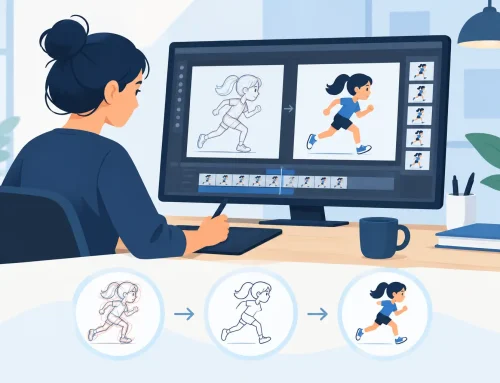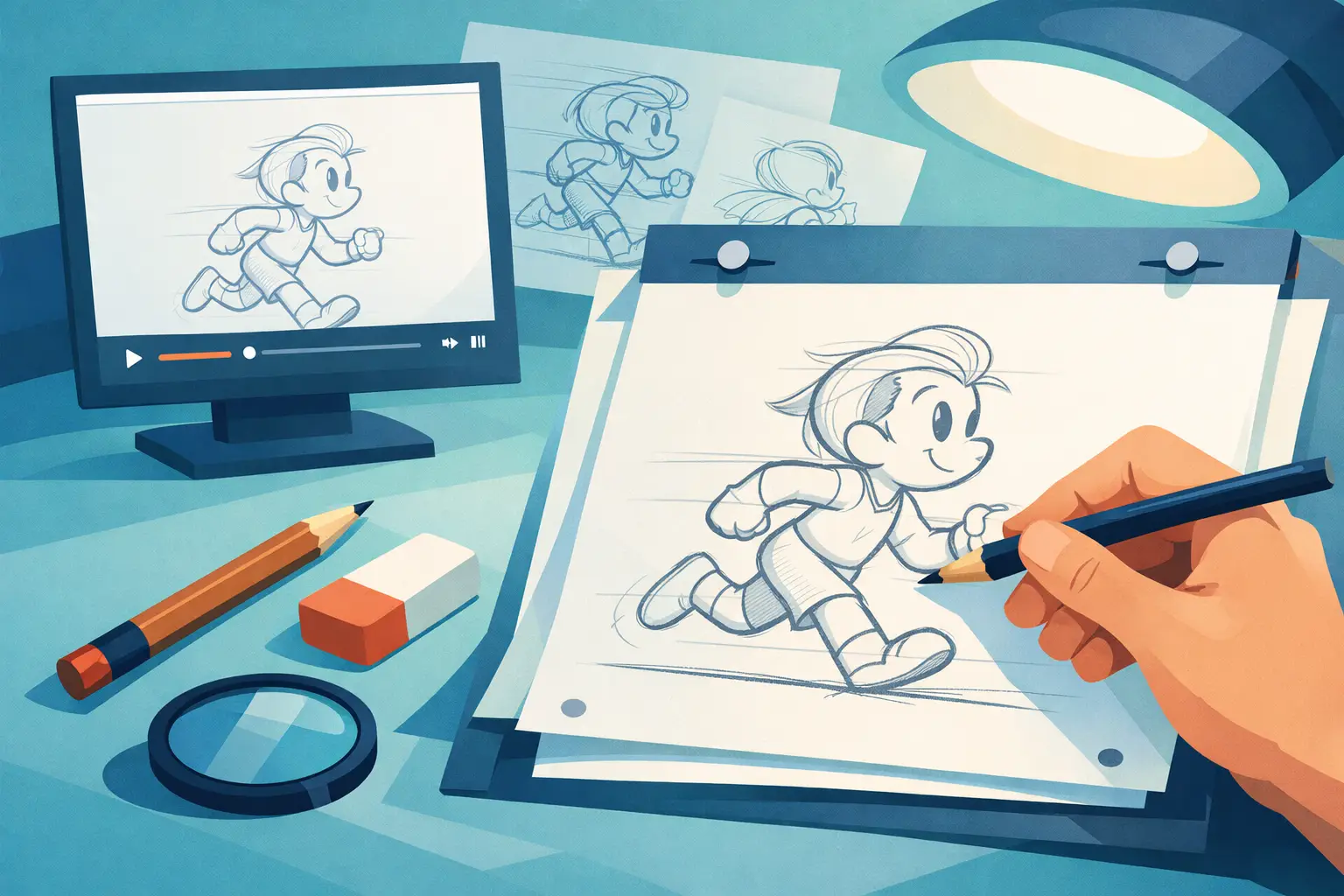
A character can be beautifully drawn and still fail to move. The walk may feel heavy, a head turn may snap too soon, or a reaction may arrive one beat late. That is exactly what a pencil test is built to catch: it lets animators judge motion before they spend time cleaning, coloring, compositing, and rendering frames that need to be changed.
What Is a Pencil Test?
A pencil test is a preview of rough animation drawings played in sequence at the intended frame rate. Traditionally, an animator photographed pencil drawings on animation paper, often under a camera, then viewed the resulting film or video to evaluate the action. The drawings were loose because the purpose was not presentation. The purpose was to test the animation.
Today, the same principle applies in digital 2D animation. Rough poses, breakdowns, and in-betweens are drawn on separate frames and played back as a scene. Whether the drawings are made with graphite, a stylus, or a digital pencil brush, the animator is looking for the same answers: Does the character feel alive? Is the timing right? Does the action read clearly?
A pencil test is sometimes called a line test, rough test, or animation test. The terms overlap, though a line test can also refer to cleaned-up line art rather than rough pencils. In regular production language, a pencil test usually means the first moving review of an animator’s rough work.
Why Pencil Tests Matter Before Cleanup
Traditional animation is built on decisions that only become visible when frames move. A single drawing can have strong draftsmanship, appealing shapes, and accurate construction, yet still be wrong for the shot. Animation is not a gallery of drawings. It is a controlled change from drawing to drawing.
The pencil test reveals whether key poses communicate the idea, whether the breakdowns create the intended path of action, and whether the spacing gives the movement weight. It also exposes problems that are expensive to discover later, such as a hand that drifts off-model, a character whose feet slide across the floor, or a blink that interrupts an important expression.
Cleanup should refine approved movement, not become a second chance to discover that the movement does not work. Paint and color work should come even later. When a scene is tested early, revisions stay fast and focused. The animator can redraw a rough, hold a pose longer, remove an in-between, or shift an entire action by a few frames without throwing away finished work.
Timing Is the First Thing You Feel
Timing is how long an action takes. It determines whether a character seems alert, tired, strong, nervous, surprised, or comedic. A pencil test makes timing impossible to ignore.
For example, a character may need to hold for a moment before reacting to bad news. On paper, that hold can look like nothing is happening. In playback, it creates anticipation and lets the audience understand the thought. Conversely, too many held frames can make a character appear frozen rather than thoughtful.
Testing also helps you choose when to animate on ones or twos. Animation on ones uses a new drawing every frame. Animation on twos holds each drawing for two frames. Neither is automatically better. Fast actions, camera moves, and subtle facial changes may need ones, while a deliberate action can work well on twos. The pencil test shows whether the choice supports the shot instead of merely following a rule.
Spacing Gives Motion Its Weight
Spacing is the distance an object travels from one drawing to the next. Evenly spaced drawings create an even speed. Drawings packed close together show slower movement, while larger gaps create faster movement.
This is where many beginning animators discover the difference between making drawings and animating. A ball can have correct poses at the top and bottom of a bounce, but if the spacing is wrong, it floats or drops like a rock. A pencil test lets you see the acceleration into the fall, the quick compression on impact, and the slower rise back toward the top.
The same applies to character acting. A hand gesture should not simply travel from point A to point B. Its spacing, arc, and settle determine whether it feels forceful, hesitant, graceful, or mechanical.
How to Make a Useful Pencil Test
Start with the story point of the shot. Before drawing, know what changes for the character and what the audience needs to notice. In a simple shot, that may be a character seeing something, understanding it, and reacting. If that progression is unclear, adding more drawings will not solve the problem.
Draw the key poses first. Keep them rough, but make the silhouette, line of action, eye direction, and balance readable. Then add breakdowns that explain how the character gets from one key pose to the next. Breakdowns are not filler. They define the arc, the twist, the leading action, and the mechanics of the move.
Next, play the shot at its intended frame rate. Do not judge it by flipping through drawings slowly or staring at individual frames. Watch the action run. Then scrub through the problem area and identify the actual cause. A move that feels too slow may need fewer frames, but it may also need stronger posing or wider spacing. A move that feels jerky may need another in-between, or it may need a better breakdown.
Add a simple temporary soundtrack when dialogue, music cues, or sound effects drive the action. A reaction that works silently can be late against the dialogue. Lip-sync should also be tested in motion, because the shape of a mouth drawing matters less than whether the mouth changes land on the correct sounds.
Finally, revise only what the test tells you to revise. Avoid polishing every rough drawing after each pass. Fix the clearest problem, test again, and move forward when the scene communicates the intended action.
How to Read a Pencil Test Like an Animator
Watch a pencil test more than once, with a different question each time. On the first viewing, watch it normally. If the action reads immediately, the shot has a solid foundation. On the second viewing, ignore the character’s face and look at the body mechanics, center of gravity, and contact points. Then watch the face, hands, and eye direction for acting clarity.
It also helps to watch with the sound off. Without dialogue or music guiding your reaction, you can tell whether the pose-to-pose storytelling works visually. Then restore the sound and check whether the action supports the track rather than competing with it.
Experienced animators often look for unintended motion between the major actions. A shoulder may creep upward, a character’s head may vibrate from inconsistent volume, or a planted foot may slide one pixel at a time. These flaws are easier to correct in rough animation than after clean lines and color make every revision more labor-intensive.
Common Pencil Test Problems
The most common problem is judging drawings individually instead of judging the scene in playback. Another is adding in-betweens too early. More drawings do not automatically create smoother animation. If the keys and breakdowns do not clearly describe the action, extra in-betweens often create a smoother version of an unclear move.
Overworking roughs is another costly habit. A pencil test should be clear enough to evaluate, not finished enough to frame. Loose construction lines are acceptable if the pose, volume, and action can be read. Save clean contours and final details for after the motion is approved.
Timing changes can also become tedious in software that forces a stop-adjust-preview cycle. In FlipBook, timing can be adjusted while the scene plays, so you can feel a hold, shorten a reaction, or retime an action without breaking concentration. That keeps the test where it belongs: in the animator’s hands, not buried in a technical process.
Pencil Tests Are Where the Performance Begins
A good pencil test does more than confirm that a character moves from one pose to another. It exposes thought, force, rhythm, and intention while the animation is still flexible enough to improve. That is why professional animators test rough work early and often.
Keep your drawings loose, play the scene constantly, and trust what the motion tells you. When the rough test has weight, clarity, and life, cleanup becomes a reward instead of a rescue job.