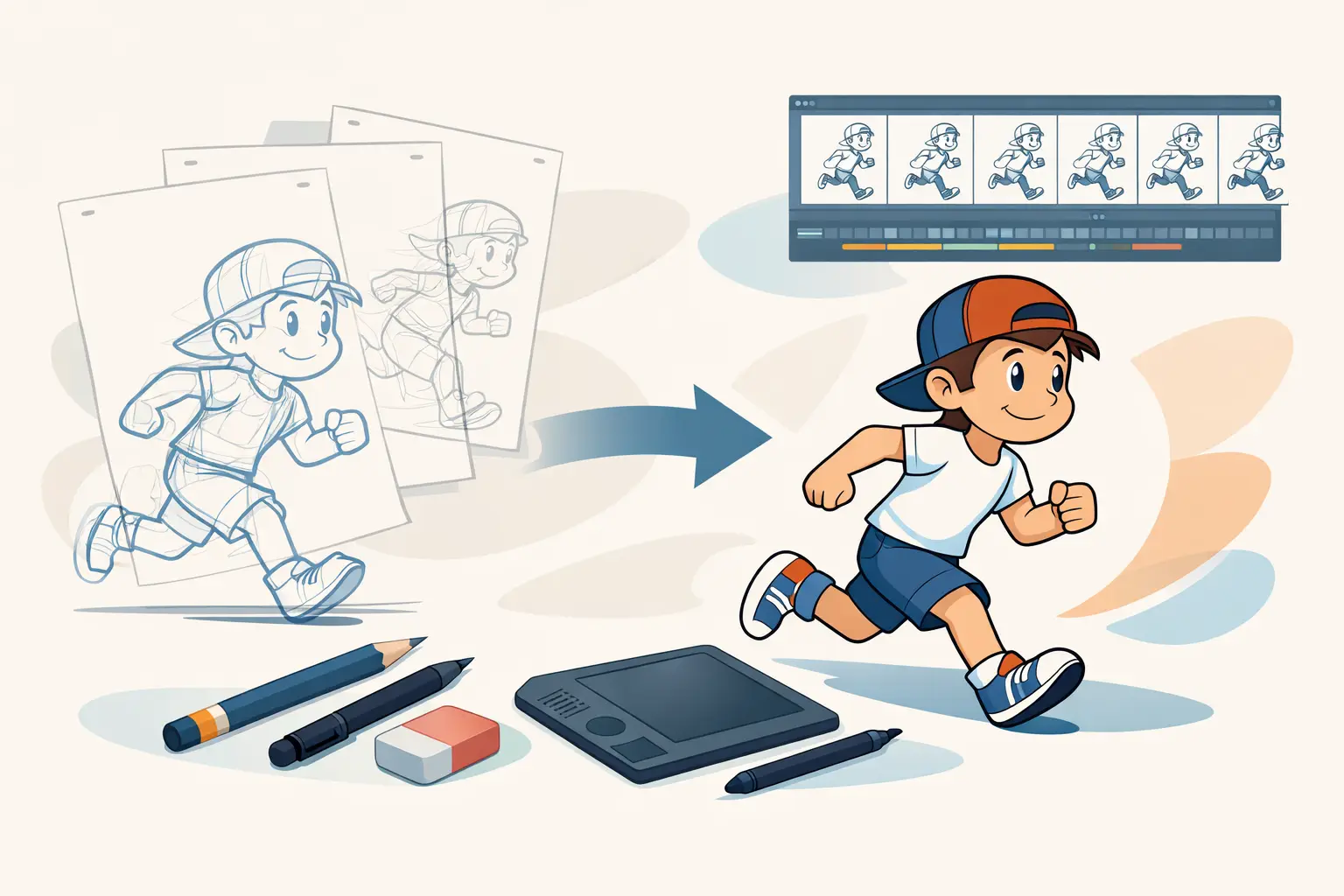
A rough animation can have terrific acting, strong arcs, and exactly the right timing, then lose its force during cleanup. That usually happens when cleanup becomes tracing instead of a deliberate drawing pass. This hand drawn cleanup workflow guide keeps the original performance intact while producing clear, paint-ready drawings that hold together from frame to frame.
Cleanup is not about making every line pretty. It is about making every drawing readable, consistent, and practical for the next person in the pipeline – even if that next person is you. The best cleanup preserves the animator’s intent, simplifies what does not need to move, and gives paint a closed, dependable drawing to work with.
Start Cleanup Only After the Scene Plays Correctly
Do not use cleanup to solve animation problems that belong in roughs. Before you commit to a clean line, scrub the scene and play it repeatedly at speed. Check the pose-to-pose rhythm, the spacing through actions, the eye direction, and the relationship between the character and the frame. If an arc wobbles or a hold feels dead, repair it in rough animation first.
This discipline saves hours. A polished drawing with bad timing is still bad animation, and redrawing clean frames after a timing change is one of the most expensive mistakes in a hand-drawn production.
Mark the drawings that are truly approved. Keys, breakdowns, and extremes deserve the closest attention because they establish the structure for every inbetween. If a key pose is vague, no amount of careful linework will make the scene feel solid.
Work From the Scene’s Visual Priority
Not every part of a drawing needs the same level of control. The face, hands, silhouette, and contact points carry most of the audience’s attention. A character’s collar, distant fingers, or a small wrinkle may need less information, particularly in a fast action.
Think like a production artist. Put effort where the camera and the performance demand it. Cleaning every minor detail on every frame can make a lively scene look stiff, and it slows paint for no visible gain.
Build a Clean Line That Can Survive Motion
Choose a line weight that reads at the final viewing size. A line that looks elegant while zoomed in can disappear during playback, while a heavy line can close narrow gaps and make the drawing look cramped. Test a few cleaned frames at actual scene size before you clean the entire shot.
Use the rough drawing as information, not as a prison. Follow the construction, the pose, and the volume, but do not copy every searching line. If the rough line drifts, choose the cleanest intended contour. If the animator has drawn a loose, expressive shape, retain its character rather than replacing it with a mechanical curve.
Consistency comes from understanding form. A cheek, cylinder, shoe, or sleeve should keep its intended volume as it turns. It does not need to match the previous drawing pixel for pixel. It needs to look like the same object moving through space.
Choose What Must Stay Registered
Registration is especially important in features that viewers use to judge stability. Keep pupils, mouth corners, hairlines, costume seams, and joint connections under control. On a held head, for example, an eye that crawls a fraction of an inch between drawings can be more distracting than a slightly loose outer contour.
That does not mean locking down every feature. A living character has controlled variation. The useful question is whether a shift supports the action or simply advertises the cleanup process. If it does not support the action, correct it.
Use nearby frames and onion-skin views to compare placement, but always return to playback. A drawing can look perfectly aligned as a still image and still chatter when the scene runs. The audience sees movement, not your zoomed-in workspace.
A Hand Drawn Cleanup Workflow Guide for Each Pass
A reliable cleanup pass follows a simple production order. First establish the silhouette and major construction. Then clean the face and hands. After that, resolve overlaps, interior details, and line closures. Finally, inspect the drawing as paint will see it.
This order prevents a familiar waste of time: carefully finishing small details, then discovering that the torso must shift to fix the silhouette. Large shapes make the shot read. Resolve them before you spend attention on eyelashes, buttons, or texture.
For characters with complicated designs, use clear internal logic. Decide where a line stops behind an overlap, which side of a seam carries the contour, and how recurring details are simplified in motion. A design sheet is useful, but the scene itself is the final authority. A turnaround may show every feature; a three-frame head turn may require only the features that sell the turn.
Clean Keys Before Inbetweens
Clean all approved key drawings first, then clean the major breakdowns. When those drawings are solid, the inbetweens have a clear target. You can see the intended changes in volume, direction, and overlap instead of guessing from loose roughs.
For a slow, deliberate action, clean more of the inbetweens carefully because the audience has time to inspect them. For a fast action, focus on readable extremes, clean accents, and any drawing that lands on a hold. It depends on the shot. The goal is not identical polish everywhere; the goal is a scene that plays cleanly.
When you work on twos, make sure the duplicate exposure does not conceal a drawing problem. A frame held for two exposures still needs to read as a purposeful image. When the timing changes to ones for a quick turn or impact, check the whole run again. The tighter rhythm will reveal line pops that were hidden on twos.
Prepare Drawings for Fast, Reliable Paint
Painting should not become a repair department. Before color begins, check for open gaps, accidental doubled lines, tiny islands, and unclear overlaps. A narrow opening in a contour may cause a fill to spill across the drawing. A stray line can create an unwanted pocket of color that takes longer to find than it does to prevent.
Be practical about line closures. Not every line in traditional animation is a literal closed shape, but every area intended for a fill needs a clear boundary. If you use an open line for a stylistic reason, make sure the paint workflow accounts for it rather than asking the color artist to guess.
Name levels and keep the scene organized. Separate character, effects, and background elements when the shot needs independent control. A simple scene may not need an elaborate stack, but a character passing behind a foreground object should not force you into destructive edits later.
Digital tools should reduce repetition without changing the way you think about drawings. In FlipBook, artists can draw roughs and cleanup, paint frames efficiently, and play the scene while adjusting timing. That matters because timing decisions belong close to the drawings. You should be able to see the result of a change while the action is alive, not interrupt the creative pass with a stop-adjust-preview routine.
Review the Scene Like an Audience Member
The final cleanup check is a playback check. Watch the scene at normal speed, then watch it again with attention on one area at a time: silhouette, face, hands, costume details, and paint boundaries. If possible, view it at the size the audience will actually see. A flaw that dominates a close zoom may be invisible in context, while a poor silhouette can be obvious from across the room.
Look for three common problems. First, line boil that is not intentional: contours that change shape without an animation reason. Second, volume drift: a head, hand, or prop gradually changes size or construction. Third, accidental tangencies: lines that touch or nearly touch in ways that flatten depth and confuse the pose.
Do not chase every fluctuation. Hand-drawn animation has life, and excessive correction can remove it. Correct the changes that distract from the performance. Leave the variation that makes the drawing feel made by an animator rather than stamped by a machine.
Know When a Shot Is Finished
A cleanup pass is finished when the action reads, the design holds, the paint areas work, and no visible defect competes with the performance. It is not finished when every line has been polished until it loses the original gesture.
That standard is useful for students and small studios alike. It gives you a practical stopping point, protects the schedule, and keeps attention on what hand-drawn animation does best: a sequence of purposeful drawings that makes an audience believe in motion.
Before you move to the next scene, play the finished shot one more time without looking for mistakes. Watch the character’s thought, weight, and rhythm. If the drawing disappears and the performance remains, your cleanup has done its job.